
Iona & The First Christians
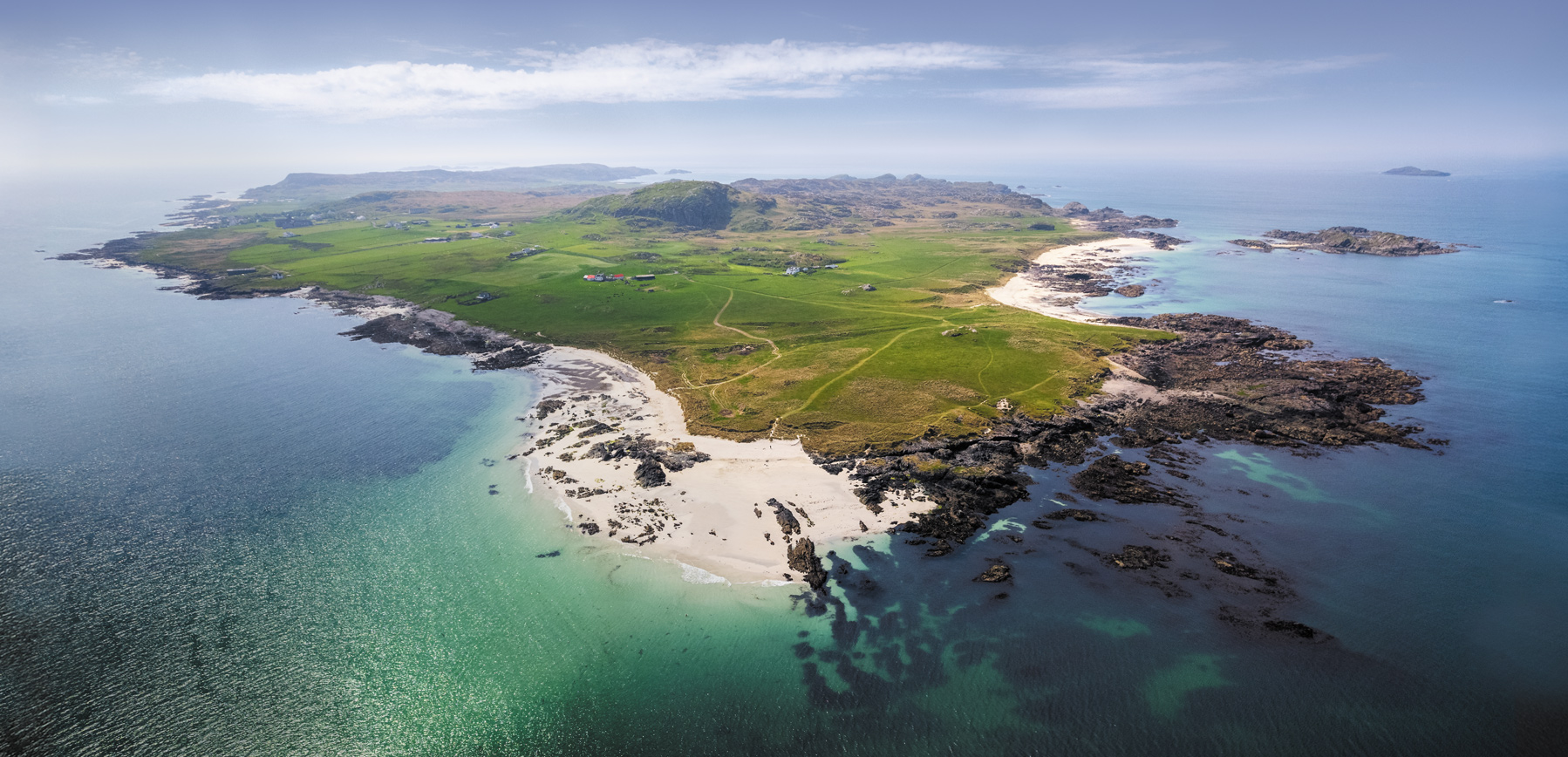
The Isle of Iona
The fabled Isle of Iona sits just off the western tip of the Ross of Mull. Steeped in history, it has played a central role in the spread of Celtic Christianity to mainland Britain and is the burial place of many early Scottish kings – including the infamous Macbeth. Each summer the resident population of less than 200 is swelled by tens of thousands of visitors arriving into the gateway settlement of Baile Mòr – many of whom are Christian pilgrims. Despite its bloody past and present-day popularity, there remains a pervasive sense of peace. On sunny days the island’s open landscape and white-sand beaches are bathed in a sparkling light that has inspired some of the nation’s most renowned artists, including the Scottish Colourists Francis Cadell and Samuel Peploe.
A Small Island with a Big History
Flint fragments left by Mesolithic hunter-gatherers suggest Iona’s human history stretches back at least 7,000 years. For millennia the island’s progress followed a similar pattern to that of its Hebridean neighbours, until its rise to prominence began in 653 with the arrival of the Irish monk Colmcille – better known today as St Columba. Columba was an Irish priest of noble birth hailing from what is now County Donegal. Having established a number of monasteries in Ireland, it is thought Columba and 12 of his followers left for Scotland after coming into conflict with the Irish King Diarmait. Upon arrival at a small bay in the south of the island (known today as St Columba’s Bay), he established Iona’s monastic community from where he spread the Christian gospel throughout northern Britain. The monastery quickly became an influential seat of learning, worship, and creativity. Columba died in 597 but the monastery continued to thrive until the first in a series of brutal Viking raids began in 795.
There are no visible remains of Columba’s original wood and turf buildings, but the surrounding vallum (an embanked boundary-marking ditch) can still be seen. Following persistent Viking raids, including the reputed massacre of 68 monks in the early 9th century, most of the monks relocated to Kells in Ireland. The widespread adoption of Roman over Celtic Christianity further reduced the monastery’s influence, although it continued to operate and serve as the burial place for Gaelic kings. Ironically, many Vikings later converted to Christianity. Around 1200 Ranald Somerled – a descendant of the Norse invaders – brought in Benedictine monks and had the abbey rebuilt along with an Augustinian nunnery nearby. The abbey flourished until the dissolution of the monasteries following the Reformation in 1560, after which it gradually fell into ruins. Restoration of the abbey was begun in the early 20th century. Today it functions as an ecumenical church and is once again an important place of pilgrimage. The nunnery was never restored but the surviving structure is still considered one the best-preserved medieval nunneries in the British Isles. Close to the nunnery are the remains of St Ronan’s, which served as Iona’s parish church from around 1200 until the Reformation, after which it too fell into disrepair. Having now been renovated, it currently holds a display of carved stones from the abbey grounds. A new parish church was finally built in 1828 – its associated manse is now home to Iona’s Heritage Centre museum.
Close to the abbey is St Oran’s Chapel. Built in the 12th century, it is the oldest surviving building in the complex. According to a macabre legend when at first the chapel Columba was trying to build kept falling down, Oran – a cousin and follower of St Columba – volunteered to be buried alive as a human sacrifice. Reilig Odhrain, the adjoining graveyard, is the burial ground of many notable historical figures. These include early Irish, Norwegian and Scottish kings, clan chiefs, and more recently that of John Smith – the leader of the UK Labour Party from 1992 until his death in 1994. By the late 17th century many of the grave slabs had eroded beyond recognition. Today the most impressive surviving slabs – and the remaining upper half of St Oran’s Cross, which once stood in the graveyard – can now be seen in the abbey’s Infirmary Museum. The museum also holds a replica of the Book of Kells and the three high crosses of St Oran, St Matthew, and St John.
Iona’s high crosses are the earliest known examples of the distinctive Celtic cross with a ring around the intersection – an innovation that may originally have had more to do with structural strengthening than aesthetics. Outside the abbey is St Martin’s Cross, the only undamaged 8th century example still in its original position. Nearby, the well-crafted 1970 concrete replica of St John’s Cross (the original is in the National Museum of Scotland) is now an A-listed historic monument in its own right.
A short section of cobbled track that leads from St Oran’s graveyard to St Columba’s Shrine is all that remains of the original Road of the Dead – a processional way that once extended to the landing at Martyr’s Bay. From here the coffins of kings and clan chiefs would be carried to St Oran’s graveyard. During the late 15th century, the Clan MacLean commissioned another towering cross to stand along the track. Known as MacLean’s Cross, it was hewn from a single block of granite standing over 3 metres tall. It is intricately carved with geometric plait work and foliage as well as animals and a crucifixion scene on the wheel head.
The abbey’s cloisters were largely rebuilt during 20th century renovations and medieval grave slabs have been relocated to line the outer walls. The original walkways would have been decoratively painted. In the courtyard is the large 20th century bronze sculpture The Descent of the Spirit, donated by the Jewish Lithuanian sculptor Jacques Lipchitz.
The Well of Age
The island’s highest point is Dùn I – meaning the Hill of Iona. The site of an Iron Age fort, the 101 metre summit has far-reaching views over Iona and the surrounding islands. Close to the summit is Tobar na h-Aoise or the Well of Age. Legend has it that touching its magical waters at sunrise is rejuvenating.
Beaches and Bays
Iona’s rocky coastline is interspersed with idyllic sandy bays and beaches backing onto machair. Just south of Baile Mòr is Martyr’s Bay – named in memory of the monks massacred there by raiding Vikings. On the west side is Camus Cuil an t-Saimh – Bay at the Back of the Ocean. The west coast is exposed to the full force of the Atlantic and the prevailing winds – when the conditions are right, great fountains of spray burst skyward from Spouting Cave to the south of the bay. Flanking Iona’s north and inspiration for the Scottish Colourists are the east-facing Traigh Ban Nam Monach – White Strand of the Monks – and the north-facing Traigh an t-Suidhe – Strand of the Seat. In the south the pebble beach of St Columba’s Bay looks out to a series of islets and skerries that serve as breeding grounds for Atlantic seals and seabirds.