
Staffa & Fingal’s Cave
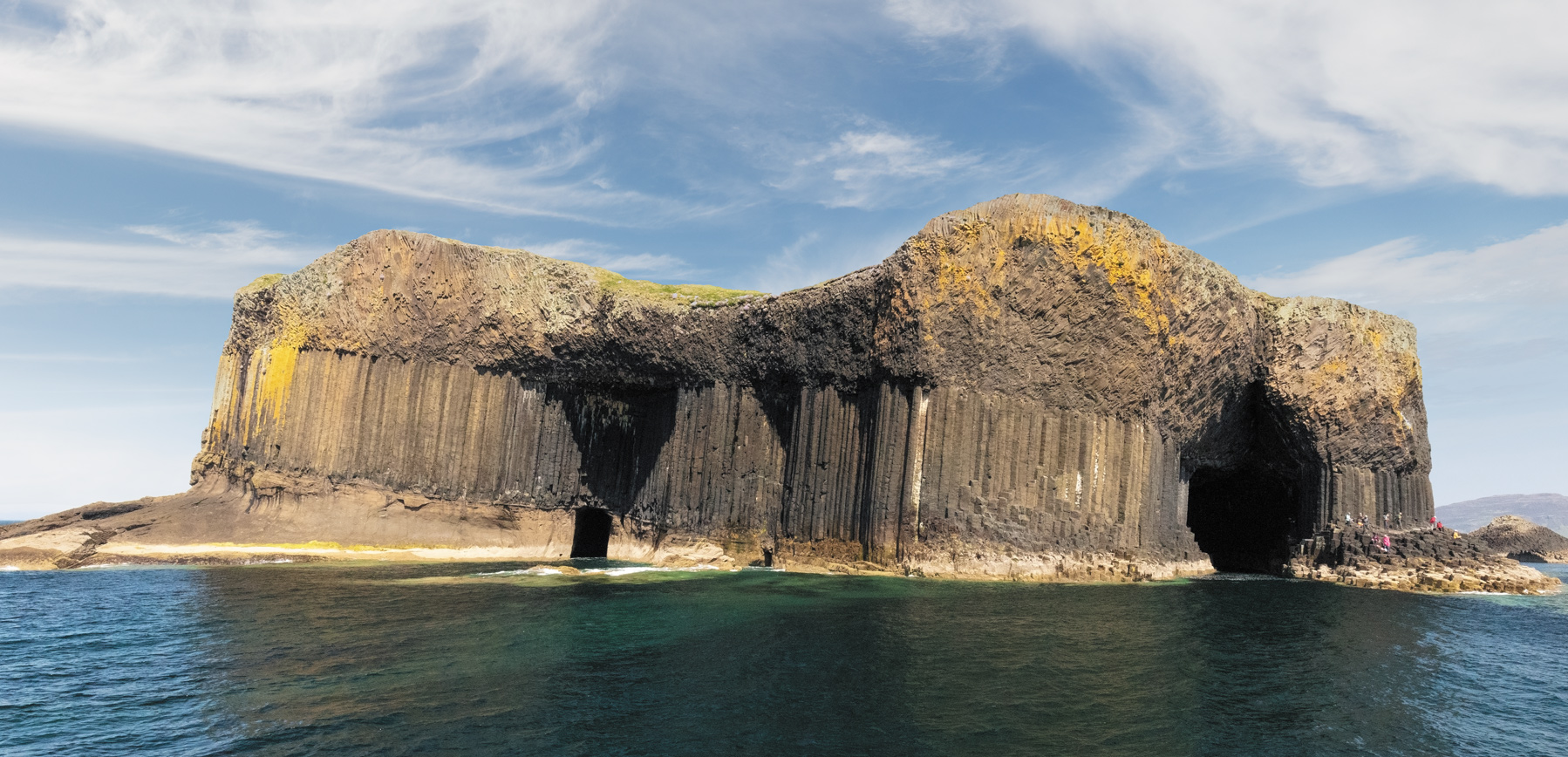
The Isle of Staffa
Less than 10 kilometres off the west coast of Mull is the Isle of Staffa, a stunning example of columnar basalt and one of the British Isles’ most outstanding natural wonders. The island is composed of three distinct layers of rock, tilting downwards from west to east. The base is tuff – compressed volcanic ash and dust. Above this stands Staffa’s extraordinary colonnades of basalt – formed as lava slowly cooled and condensed to leave a network of uniform, mostly hexagonal fractures known as columnar jointing. The upper layer of rock is a jumble of disjointed columns and fragments of volcanic debris, topped with reeds and grasses.
The island’s coastline has a number of notable caves, including the east coast’s Goat and Clamshell Caves – both of which are impressive in their own right. However, it is the superlative Fingal’s Cave that steals the show. Formed entirely of columnar basalt, its enormous maw reaches at least 75 metres in from the southern tip of the island. Thought to be named after the legendary 13th century Irish warrior Finn MacCumhaill, Fingal’s Cave is a natural cathedral with outstanding acoustics. After visiting in 1829, Mendelssohn was inspired to compose his popular Hebrides Overture. Other famous visitors inspired by Fingal’s Cave include John Keats, William Wordsworth, Sir Walter Scott and J. M. W. Turner.
In 1997 grazing animals were removed from Staffa and in 2001 it was designated a National Nature Reserve. It is a sanctuary for many seabirds and variously hosts great skuas, guillemots, razorbills, great northern divers, fulmars, and puffins. The surrounding waters are frequented by porpoises and dolphins and by basking sharks, minke whales, and fin whales in summer.