
The Treshnish Isles
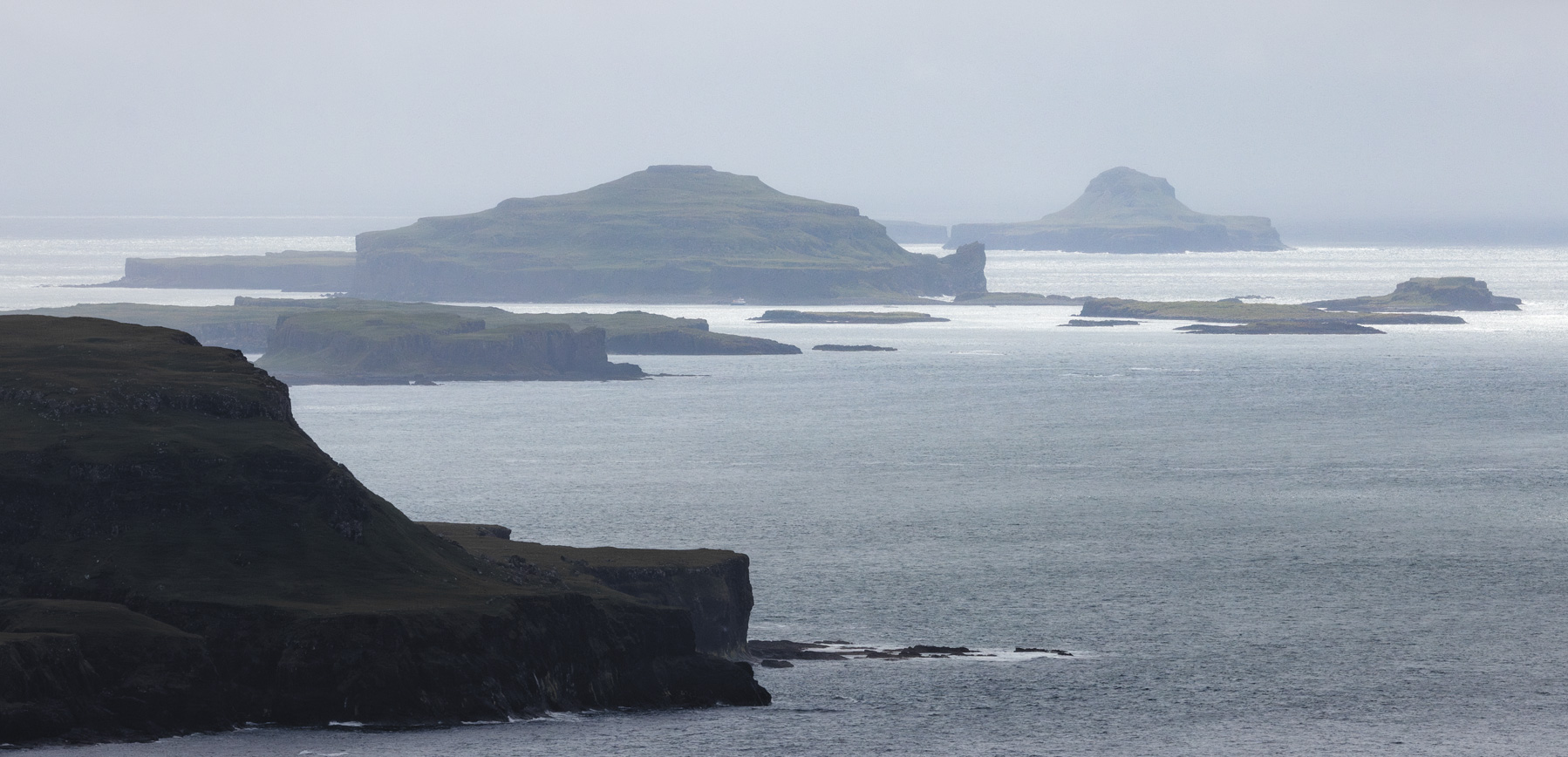
The Treshnish Isles
The Treshnish Isles are a small archipelago of eight main islands and a sprinkle of islets and skerries lying just a few kilometres off the west coast of Mull. Volcanic in origin, their distinctive profiles have served as way markers for millennia – particularly the Isle of Bac Mòr, known colloquially as The Dutchman’s Cap. Although now uninhabited, the ruins of Iron Age forts and medieval castles are evidence the islands were once strategically important. Human occupation lasted at least a thousand years, with the last family abandoning the largest island of Lunga in the 1850s.
Today the archipelago is protected as a Site of Special Scientific Interest and is a birdwatcher’s utopia. The islands are an internationally important sanctuary for many seabirds, including storm petrels, kittiwakes, shags, fulmars, and skuas. There are also colonies of burrow-nesting razorbills and puffins entirely at ease with human presence – the theory being we deter predatory skuas and gulls. On the west coast of Lunga, the Harp Rock sea stack hosts a raucous, seasonal colony of around 8,000 guillemots.